Engineering the Cube: A Technical Deep-Dive into 3D Sudoku
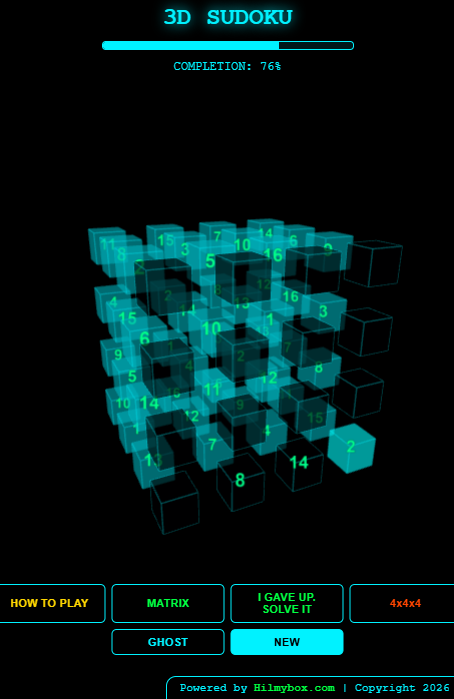
In the world of puzzle games, Sudoku has long been a staple of logic and patience. However, shifting this 2D classic into a three-dimensional space introduces a complex layer of engineering challenges that go far beyond simple visualization. This project represents the development of a fully interactive, browser-based 3D Sudoku environment that leverages hardware acceleration and advanced mathematical validation to create a seamless user experience.
By combining the Three.js library for high-performance WebGL rendering with a robust Recursive Backtracking Algorithm, the application enforces strict multi-planar constraints across every axis of a 27 or 64-cell cube. From the implementation of a responsive, touch-friendly interface to the real-time synthesis of spatial audio via the Web Audio API, this technical breakdown explores the intersection of procedural logic and front-end performance. Whether you are interested in the geometry of 3D sub-grids or the mechanics of 3D raycasting, this exploration reveals the core engine that powers a truly modern puzzle experience.
Click here to access.
1. The Core Engine
The logic core of this application is a 3D Backtracking Algorithm designed to handle multi-planar spatial constraints.
- Recursive Backtracking: The engine systematically attempts to fill empty cells using a depth-first search, reverting (backtracking) whenever a mathematical conflict is detected.
- 3D Validation Engine: Unlike traditional 2D Sudoku, this engine enforces uniqueness across X (Row), Y (Column), and Z (Pillar) axes simultaneously.
- Sub-Grid Logic: It dynamically calculates 3x3 or 4x4 sub-grid boundaries for every 2D "slice" of the cube to ensure local block uniqueness.
- Integrity Guard: A mutation observer is implemented to prevent the removal of branding elements, forcing a system reboot if the DOM is tampered with.
2. Rendering Technology
The project utilizes WebGL through the Three.js library to create a hardware-accelerated 3D environment.
- Scene Graph Management: High-level abstraction of 3D objects, lights, and cameras within a
THREE.Scene. - Dynamic Materials: Uses
MeshPhongMaterialfor translucent cubes andSpriteMaterialfor rendering numbers as 2D textures that always face the camera. - Emissive Glow Mapping: Real-time manipulation of
emissiveIntensitycreates pulsing neon effects for selected cells and red warning glows for conflicts. - Raycasting: A
THREE.Raycasteris used to project 2D screen mouse/touch coordinates into 3D space to detect cell selection.
3. Mathematical Tools
The application relies on Euclidean Geometry and Vector Mathematics to manage the spatial grid.
- Coordinate Mapping: Cells are indexed via a (x, y, z) system, which is mathematically mapped to 3D world space using a
spacingconstant and a centeredoffsetformula: x * spacing - offset. - Sub-Grid Hashing: The sub-grid location is determined using floor division: [coordinate / blockSize] x blockSize.
- Linear Interpolation (Lerp): While not explicitly in the final loop for movement, the system uses standard frame-based rotations theta = theta + 0.001 for the cube group.
- Audio Frequency Modulation: Vertical Y-coordinates are mapped to Hertz (freq = 220 + (y x 110)) to generate unique pitched tones based on cell height.
4. Front-End Environment
The environment is built using a Responsive Web Stack designed for cross-platform compatibility.
- Three.js (ES Modules): Modern JavaScript module imports are handled via
importmapfor efficient resource loading. - CSS Flexbox & Grid: The UI uses
display: gridfor the numpad andflexboxfor the sidebar to remain responsive across desktop, iPad, and mobile devices. - Web Audio API: Real-time synthesis of
OscillatorNodes(Sine and Sawtooth waves) provides immersive haptic-like sound feedback without external audio files. - Media Queries: Breakpoints at 600px allow the interface to switch from fixed sidebars to a touch-optimized bottom menu for portrait mobile layouts.