Real-Time Modal Analysis: Visualizing Signal Decomposition in 3D Space
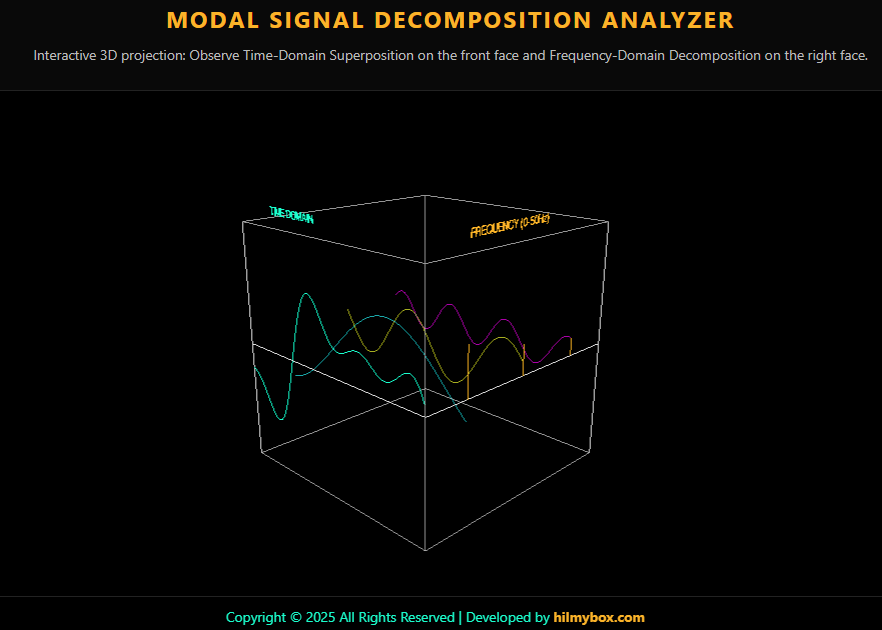
Explores a high-fidelity diagnostic terminal designed to bridge the gap between abstract signal processing and intuitive visualization. By utilizing a transparent coordinate cube, the application demonstrates how complex waveforms—composed of multiple sinusoidal inputs—can be broken down into their constituent parts. We delve into how the system calculates Time-Domain Superposition and simultaneously projects a Frequency-Domain Decomposition (FFT). It is an essential look at how 3D web technologies can make the principles of harmonics and spectral analysis accessible to engineers and students alike.
Click here to access.
1. The Core Engine
The logic of the application is driven by a custom sinusoidal summation engine. It processes three independent signal channels, each with adjustable parameters:
- Amplitude (A): Determines the peak strength of the wave.
- Frequency (f): Sets the oscillation rate (0–50 Hz).
- Time Dilation: A global multiplier that allows the user to slow down or speed up the motion of the physics simulation.
The engine calculates the resulting waveform using the principle of superposition:
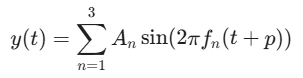
where p represents the phase shift along the X-axis of the 3D cube.
2. Rendering Technology
The visual layer is powered by Three.js (WebGL), utilizing a specialized graphics pipeline:
- Geometry: Uses
LineSegmentswithEdgesGeometryto create a clean, diagonal-free 3D wireframe box. - Post-Processing: Implements an
EffectComposerwith anUnrealBloomPassto create a "neon" or "diagnostic glow" effect typical of high-end terminal interfaces. - Dynamic Buffers: The waveforms are rendered using
BufferGeometry, which is updated every frame to allow for smooth, 60fps movement of the signals.
3. Mathematical Tools
The application relies on several mathematical concepts to map data into 3D space:
- Trigonometry: Sine functions drive the oscillation of the internal and resultant lines.
- Discrete Projection: The "Frequency Domain" is modeled as a discrete spectral analysis, where the height of the vertical bars at the "Right Face" of the cube corresponds to the input amplitude at a specific Z-coordinate (representing frequency).
- Vector Calculus: Uses
THREE.Vector3for coordinate mapping, ensuring that as frequencies increase, the signals move further back along the Z-axis (2 - (f/50) x 4).
4. Front-End Environment
The interface is built with a modern, responsive web stack:
- HTML5/CSS3: Utilizes CSS Flexbox for centering the viewport and Media Queries to ensure the terminal is "tablet-friendly," stacking the controls on top for portrait orientations.
- ES6 Modules: The JavaScript is written using
importmaps, pulling directly from CDNs to ensure the latest versions of the Three.js library. - Interactive UI: A sidebar panel utilizing range inputs for real-time manipulation of the 3D scene without requiring a page reload.